
ARTISAN BUTTER, THE ART OF THE BUTTER LOAF

Eight kilos per person per year. That is the amount of butter consumed in France, making the country the world’s leading consumer, according to an infographic from the Ministry of Agriculture.
The same source points out that it takes 22 kilos of milk to produce one kilo of butter. Behind this everyday product lies a true craft, which Le Monde highlights in "Au bon beurre, mottes d’emploi: from the source of the milk to churning", a feature by Zazie Tavitian published on 7 May 2026 in M Le magazine du Monde. At the Cheese and Dairy Products Show, butter even has its own section of exhibitors, alongside eggs and other dairy products.
It all begins in the barn
Good butter comes from good milk. The Le Monde feature follows Léa Baril and Étienne Aubin at the Ferme de la Beucherie in Le Theil-de-Bretagne (Ille-et-Vilaine).
The couple rear Froment du Léon cows, a Breton breed they are helping to preserve. Every Saturday, at the Marché des Lices in Rennes, a 200‑gram block of raw butter sells for 5 euros, and it sells out well before the market closes.
The choice of breed is crucial. According to Le Monde, a Froment du Léon produces 15 to 18 litres of milk a day, whilst a Prim’Holstein can produce up to 40 litres. This modest yield explains why the breed fell out of favour after the war. Its milk, however, is very high in fat and retains the beta-carotene from fresh grass, hence the bright yellow colour of its butter. A document from the Conservatoire des races animales reports that the breed’s population fell from 35,000 cows in 1907 to around forty by the late 1970s, before a conservation programme was launched.
The butter-maker’s process, step by step
On the farm, the production process follows a precise routine. The raw milk collected after milking passes through a skimmer, which separates the cream from the semi-skimmed milk. The cream is inoculated with cultures and left to thicken for twenty-four hours. It is then poured into a small churn, whose paddles break down the fat globules until the solids separate from the buttermilk, known as “lait ribot” in Brittany.
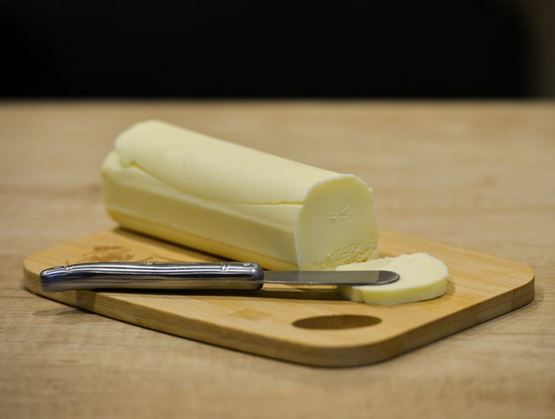
The butter is then rinsed several times with clean water, seasoned with fleur de sel, kneaded and then moulded by hand. Léa Baril sums up the equation in the columns of Le Monde: on average, it takes 10 litres of milk to produce one kilo of cream, which will yield around 600 grams of butter.
Processing raw milk has regulatory implications. In France, the decree of 30 December 1988 reserves the term “raw butter” for butter made exclusively from cream that has not undergone any heat treatment for sterilisation. The same decree defines “extra-fine butter”, made from cream that has been pasteurised only, never frozen and processed within specified timeframes, and “fine butter”, for which the proportion of frozen raw material does not exceed 30 per cent.
Kneading: the hallmark of an artisan
Once churned, the butter can still be further processed. This is the very essence of Maison Bordier’s craft. In 1985, Jean‑Yves Bordier took over La Maison du Beurre in Saint‑Malo, a dairy that carries on the methods of the 19th‑century butter churners and kneaders. The process involves purchasing churned butter from local producers and then re-kneading it to refine its texture and flavour. As early as 1986, the company created its first flavoured butter: a lightly salted variety with seaweed, born of an impromptu pairing with a barbue fish. Since 2005, its re-kneading workshops have been based in Noyal‑sur‑Vilaine, near Rennes, next to the Olga dairy, which produces the churned butter.
This expertise also inspires chefs. Le Monde quotes pastry chef Thomas Hardy, from the Auberge du Pont d’Acigné in Noyal‑sur‑Vilaine, who serves raw butter from the Ferme de la Beucherie at his restaurant and makes ice cream using ribot milk.
Three designations, three expressions of the terroir
French butter has three PDOs: Charentes-Poitou butter, Isigny butter and Bresse butter. According to the 2025 key figures from the CNAOL and the INAO, published in September 2026, these three designations accounted for a total of 30,141 tonnes sold in 2025, up 6 per cent year-on-year, representing 8 per cent of national butter production. Charentes-Poitou butter alone accounts for 73 per cent of the total volume, with 22,074 tonnes, ahead of Isigny butter (7,478 tonnes) and Bresse butter (589 tonnes), which has more than doubled in volume since 2015.
Each set of specifications reflects a distinct identity. Those for Charentes-Poitou butter, which has held Protected Designation of Origin status since 1979, require the cream to undergo biological maturation and permit churning in wooden churns, stainless-steel churns or a butter-making machine. The milk comes from Charente, Charente-Maritime, Deux-Sèvres, Vendée or Vienne, as well as from a few neighbouring municipalities.
Isigny butter is produced around the Baie des Veys, across 175 municipalities in the departments of Manche and Calvados. Cows graze there for at least seven months a year, and the cream is left to mature for a minimum of twelve hours before churning. The specification describes a butter with a natural colour ranging from ivory to “buttercup” yellow, a shade enhanced during the grazing season by the carotenoids in the grass.
A market that values quality
In the supermarket sector, PDO butters occupy a niche but stable position. According to the same key figures from the CNAOL and the INAO, compiled from the Circana panel for the CNIEL, their sales in supermarkets, hard discount stores and drive-through outlets are set to reach 6,621 tonnes in 2025, representing 4.3% of volumes and 4.6% of the value of the butter section. The average price of PDO butter stands at €11.81 per kilo, compared with €11.14 for non‑PDO butters. For dairy and cheese retailers and dairy department managers, these figures confirm that consumers are willing to pay more for butter whose origin and production method they are familiar with.
From the fat of the “Barbarians” to French gastronomy
In La Guerre du gras (Nouriturfu, 2025), Nicolas Kayser‑Bril points out that in antiquity, dairy products were seen as the food of “barbarian” peoples, in contrast to the Greek and Roman civilisations, which were based on olive oil. Quoted by Le Monde, he traces the rise of butter in French bourgeois cuisine from the 16th century onwards.
In the kitchen: a flavour enhancer
Today, butter remains a mainstay of professional kitchens. In the Le Monde feature, Parisian chef Léa Lestage explains that she uses eight kilos of butter a week, for fish, meat, puff pastry and sauces. She prefers to sear meat in oil, as butter has a fairly low smoke point, then adds butter at the end of cooking to coat the food and bring out the flavours. Her advice is practical: semi-salted raw butter for morning toast, and a more affordable quality of butter for cooking.
A trade show to meet butter buyers
The Cheese and Dairy Products Show offers butter producers a venue for tastings and meetings with cheese and dairy retailers, supermarket buyers, wholesalers, importers and restaurateurs.
The 2026 edition brought together 270 exhibitors representing nearly 400 brands and 7,600 trade visitors. International visitors accounted for 26% of the audience, coming from 74 countries, and the number of foreign buyers rose by 25% compared with 2024. Nearly 1,500 business meetings had been scheduled by the time the event opened.
As for the exhibitors, 48% came from abroad, from 15 countries, and 33% were taking part for the first time. The 2026 edition was held alongside Gourmet Selection, the premium food and drink trade fair, which further broadened the pool of buyers in attendance.