28/10/2026
WHAT CHEESEMONGERS ARE LOOKING FOR

Belgium, France, the United Kingdom, Italy: the four buyers interviewed operate in different markets, with distinct business models. One runs several local dairy shops, one of which combines the shop with a cheese bar.
The second manages the cheese range for a national chain of organic shops. The third supplies independent shops and restaurants. The fourth runs a specialist cheese shop in Italy. Yet their comments paint a consistent picture of today’s cheese buyer. They are discerning about provenance, drawn to cheeses with character, and convinced that tasting remains the best selling point.
Four buyers, four markets, one meeting
Julie Moulia is a cheesemonger in Belgium. In 2017, she took over Le Plateau du Berger, a cheese shop and cheese bar in Ixelles, and then in 2020 La Petite Vache, one of the oldest cheese shops in Brussels, in Saint-Josse. She then opened La Crémerie de Lasne, in Walloon Brabant.
Romain Cazorla is the cheese category manager at Biocoop, a cooperative network of organic shops. In this role, he oversees the range of cheeses available in the chain’s shops.
Patrick Spinazza is Sales Manager and Head of Cheese at Curd & Cure, an independent wholesaler of speciality cheeses and fine foods based in Kent, and a judge at the World Cheese Awards. The company supplies farm shops, delicatessens, upmarket retailers, caterers and catering groups across the United Kingdom.
Roberto Guermandi has been the owner of L’Angolo della Freschezza, a specialist cheese shop in Bologna, since 1993. Crowned Italy’s best cheesemonger in 2022 at the Gran Premio del Formaggiaio, he represented Italy at the 2023 World’s Best Cheesemonger Competition in Tours. He has also been a judge at the World Cheese Awards since 2018 and supplies several Michelin-starred restaurants.
Find out more about our meeting with Mr Azzoug at the last edition of the Cheese and Dairy Products Show
Julie Moulia: “You have to give cheese a chance”
Julie Moulia has been attending the show for several years now, with two objectives. She is on the lookout for new products and seeks to strengthen her relationships with the producers who already supply her. This year, she was struck by the presence of numerous foreign producers and importers, particularly from Spain and Italy, but also from Portugal and the UK. “It’s also lovely to discover cheeses we’re a little less familiar with,” she sums up.
Her cheese shops specialise in raw milk, and she prioritises sourcing from small-scale producers.
On its website, Le Plateau du Berger also highlights cheeses from farms practising sustainable agriculture. Its range remains predominantly French, is gradually expanding to include Belgian cheeses, and she now hopes to open it up to Italian and Spanish producers.
As for her customers, she has observed specific expectations: raw milk, small-scale producers, traceable origins, but also something new. “People tend to be quite traditional, but if you get them to venture off the beaten track, they’ll go for it.” For a cheesemonger, this is an opportunity to go beyond just PDO cheeses, which she also appreciates.
Her approach is based on tasting and rotation. Alongside her classics, she introduces a new cheese for a month, then replaces it with another the following month. She then waits for customers to ask for it before putting it back on the shelves. “We create desire,” she explains, playing on scarcity.
The cheese bar at Le Plateau du Berger serves as a testing ground. The bar organises raclette evenings, fondue evenings and “cheesy parties” with a buffet of 25 cheeses. These events attract a younger clientele, more open to new products. This development ties in with one of the trends highlighted in the 2026 Trend Report from the Cheese and Dairy Products Show, which shows cheese moving beyond the traditional cheese platter to feature in aperitifs, brunch, cooking and snacking.
Her favourite cheese, however, remains a classic: a goat’s cheese called Selles-sur-Cher.
At Biocoop: a link to the local area and fair pay
Romain Cazorla attended the show to meet the retailer’s suppliers, discover new products and identify market trends for 2026 and 2027. Discussions are underway with several new producers, which could lead to collaborations. “It really is a breeding ground,” he emphasises. He also came to gauge the mood within the supply chains and the retail sector, particularly amongst cheese shops, and to spot “hidden gems” that the chain might not necessarily have thought of.
In his view, customers at organic shops are primarily looking for a connection to the land, a link to the local terroir and as much local produce as possible. The chain is following the market trend for Mediterranean cheeses, with Italian varieties leading the way. However, it maintains a strong local focus, featuring well-known PDOs and PGIs, and a large proportion of sheep’s and goat’s milk cheeses. Raw-milk and farmhouse cheeses also remain in high demand.
Fair trade is a key selection criterion. Biocoop enshrined its principles in its charter as early as 1992 and supported the creation of the Bio Équitable label in France.
Romain Cazorla cites three sectors – cow, sheep and goat – on which the chain places particular emphasis, as producers in these sectors are paid a fair price. “The organic sector has seen somewhat up-and-down trends,” he acknowledges, before highlighting a recovery since 2023. According to him, the chain grew by more than 7 per cent in 2025, has opened around ten shops since the start of 2026 and plans to open another ten or so by the end of the year.
The cheese counter is following the same trend, driven by a return of customers. Of the network’s roughly 740 shops, more than 600 have a cheese counter where cheese is cut to order, and each shop offers an average of 240 different cheeses. This service helps maintain a personal connection with customers.
The cheese that best embodies the brand’s values is, in his view, a block of feta-style sheep’s milk cheese produced in Aveyron by Gabriel Coulet, a family-run business specialising in Roquefort PDO.
The milk comes from the Aveyron Brebis Bio cooperative, which brings together producers of organic sheep’s milk from the Aveyron region. The cheese carries the Bio Équitable label in France, with a guaranteed minimum price for producers and a purchase commitment of at least three years.
This makes it possible to offer consumers a “reasonable” price whilst ensuring farmers receive a fair income. “The whole value chain benefits,” summarises Romain Cazorla.
United Kingdom: standing out to avoid the price war
Since the summer of 2025, Great Britain has suspended imports of raw milk and raw milk dairy products from Italy, France and then Spain, following outbreaks of contagious nodular dermatosis. As the Academy of Cheese points out, this bovine disease is not transmissible to humans. However, many European cheeses that are popular across the Channel are made from raw or lightly pasteurised milk.
Patrick Spinazza attended the fair to identify new cheeses to stock and to find out more about this issue, which has directly affected his business. He also met up with his partners. According to him, the crisis initially accelerated a shift towards British cheeses. Today, however, independent retailers are instead seeking out more distinctive products to set themselves apart. Alpine cheeses are in high demand across the Channel, as are lactic-fermented cheeses.
He identifies several consumer profiles. The general public remains attached to traditional, low-cost products, particularly wax-coated cheeses. More discerning connoisseurs, on the other hand, are keen to explore new options. Encouraging the former to try artisanal cheeses, he believes, is a matter of education.
Taste, history, origin, innovation, consistency: all these criteria factor into his choices. The foremost criterion is uniqueness. He refuses to sell a cheese already stocked by a competitor, as the conversation then inevitably turns to price. He prefers to discuss provenance, what makes the cheese unique, and how it fits into the customer’s range. Seasonality is also a key factor, as Curd & Cure aims to rotate its stock throughout the year.
The guide to cheese seasonality published by the trade fair is designed precisely to help professionals keep track of these natural cycles.
What he appreciates about the trade fair is that everyone is gathered in one place, exhibitors and visitors alike. He meets friends from the industry, observes purchasing habits from other countries and discovers the history of the companies with which he hopes to grow.
Among his favourites is an Italian blue cheese selected by the maturing house Luigi Guffanti 1876, in Arona. He describes it as mild, with a hint of farminess and a long finish.
His everyday cheese, however, remains Parmigiano Reggiano, which he eats every day.
In Bologna, tradition takes precedence over innovation
Roberto Guermandi selects his suppliers based on specific criteria. He is primarily interested in the producer’s history and how they process their raw materials, particularly whether they use raw or pasteurised milk. The size of the business also matters, and he favours small producers over large industrial manufacturers. It is the taste that makes the difference: “The first thing I do is taste the cheese,” he explains.
He describes an Italian market that is returning to tradition. Customers are looking for small-scale production, operations where the origin of the milk can be traced, and small farms with few animals. More than innovation, it is the rediscovery of tradition and the countryside that is driving demand.
This trend echoes the 2026 Trends Report, which states that consumers are turning towards local produce, proximity and identifiable producers. Labels such as PDOs are highlighted as markers of trust.
Among foreign cheeses, Comté is the one that most immediately wins over customers on their first tasting. He highlights its “rich umami” and describes it as a “winner, accessible to all”. According to the INAO factsheet on Comté PDO, it is a raw cow’s milk cheese produced in the Jura Mountains. Depending on the terroir, season and age, more than 80 aromas are frequently identified in it.
A native of Bologna, Roberto Guermandi makes no compromises when it comes to Parmigiano Reggiano. For him, it only exists when aged for over 24 months, and he even prefers those aged for 30 or 36 months, to be enjoyed both as a whole cheese and grated.
According to a factsheet from ONAF, the Italian organisation of cheese tasters, the minimum maturation period for the PDO is 12 months. However, it is at around 24 months that the cheese expresses its typical characteristics, with maturation periods of 30 to 45 months offering a more intense flavour.
France is, in fact, the leading European market for Parmigiano Reggiano, where the Consortium also trains retailers in how to cut and present the cheese.
What should producers and affineurs bear in mind?
The four testimonials agree on several points. Firstly, uniqueness: a cheese that can be found everywhere reduces negotiations to a matter of price. Next comes origin, which involves an identifiable producer, a story worth telling and, very often, raw milk. Finally, there is seasonality, which buyers see as a marketing tool for refreshing the product range. For a network such as Biocoop, fair remuneration for producers is added to these criteria and determines whether the product makes it onto the shelves.
Tasting remains an essential step. Julie Moulia organises tastings to gain acceptance for new products, Patrick Spinazza talks about consumer education, and Roberto Guermandi tastes the cheese before considering anything else.
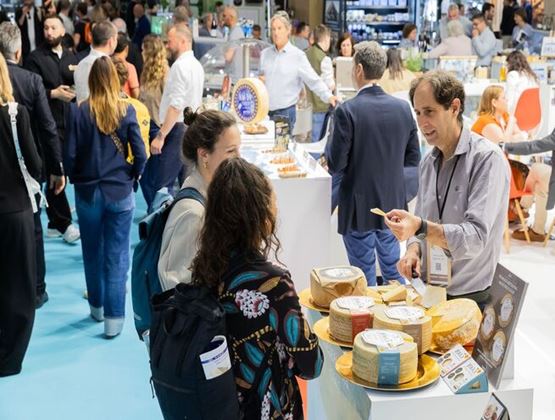
For exhibitors, this makes a strong case for stands where tastings are offered, where the story of the farm and the herd is shared, and where seasonal variations are explained.
These buyers also emphasise the value of face-to-face meetings. All stress the importance of long-term relationships with their suppliers, built up over the course of previous editions.
The 20th edition of the Cheese and Dairy Products Show will take place from 11 to 13 June 2028 at Paris Expo Porte de Versailles.