TWENTY YEARS OF EVOLUTION AT THE HEART OF THE FRENCH CHEESE INDUSTRY

CNIEL: the economic observatory for the dairy sector
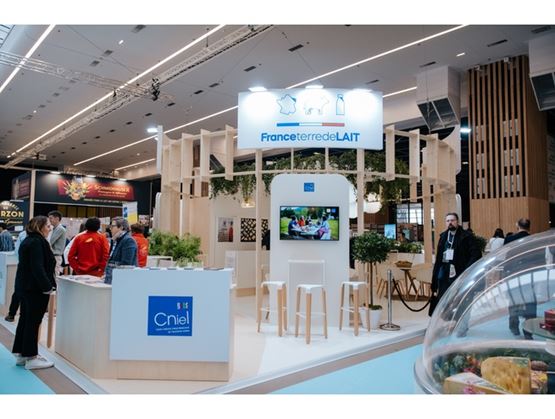
The CNIEL (National Inter-professional Centre for the Dairy Economy) brings together organisations representing cow’s milk producers, cooperatives, private dairy companies and stakeholders in the retail, distribution and catering sectors. The inter-professional body ran a joint stand there, serving as a rallying point for the dairy sector alongside the Cnaol, the Fédération des Fromagers de France, Anfopeil – the ENIL network and the French School of Cheese. “I am an economist at CNIEL, which is the inter-professional organisation for the cow’s milk sector,” says Benoît Rouyer, Director of Economic Forecasting at the organisation, whose role involves monitoring long-term changes in the sector.
Twenty years of restructuring the cheese supply
When asked about significant developments in the French cheese market, the economist identifies several underlying trends. “Among the most notable phenomena is the growth of stretched-curd cheeses, which were virtually non-existent some twenty years ago,” he observes first, referring to this family of cheeses of which mozzarella is the best-known example.
Another trend highlighted by Benoît Rouyer is the vitality of certain designations of origin: “The growth of certain designations has been remarkable, such as that of Comté, Morbier, and also Maroilles. ”
However, the cheese landscape is not evolving in a linear way. “We can also talk of somewhat chaotic developments for certain cheeses, but which may be experiencing a revival, particularly in the area of fresh cheeses, fromage frais, which are enjoying a resurgence after a more difficult period,” the economist adds.
Regional strengths, an international challenge
For Benoît Rouyer, French cheese production is characterised by its deep roots. “We are very firmly rooted in our regions, with PDOs playing a very significant role and a diverse range of production scales. We are, after all, deeply rooted in tradition, building on our strengths: soft cheeses with a bloomy rind, Emmental-type cheeses and PDOs.”
This strong identity has its downside: “Perhaps a difficulty in moving towards ingredient-type cheeses, which are the ones seeing the greatest growth internationally,” points out the economist, referring to cheeses intended for use in prepared dishes, pizzas, ready meals or as snacks.
The Cheese and Dairy Products Show offers a prime vantage point from which to observe this diversity, both in France and abroad. “It showcases the excellence of these various trades, both in France and amongst our neighbours. It really is a celebration of excellence centred on these fabulous products that are cheeses,” says Benoît Rouyer.
Young consumers: the sector’s guiding compass
Through the discussions and innovations observed, one priority stands out for the economist: “Trying to align as closely as possible with consumer expectations, and therefore paying attention to the expectations of young people, who are the consumers of the future.” These trends are analysed in depth in the NellyRodi x Cniel trend report dedicated to new perceptions and uses of dairy products.
This approach commits the entire sector to rethinking the role of cheese in meals. “It also means diversifying the ways in which cheese is used, and finding consumption opportunities beyond our traditional cheese platters, even though that’s a way of eating cheese that suits me perfectly,” he smiles. This is a key issue at the heart of the talks offered by the trade show at the Experts’ Agora, where professionals and experts share studies and insights.
Farmhouse Saint-Nectaire and Valençay: the economist’s favourites
See you in 2028 for the 20th edition
The Cheese and Dairy Products Show invites the entire industry to Paris Expo Porte de Versailles from 11 to 13 June 2028 for its 20th anniversary edition. Three days to take stock of the changes described by Benoît Rouyer: growing cheese-making families, expanding designations of origin, new consumption trends – everything that is shaping the future of the industry will be on display in the aisles, at the stands and during the fair’s highlights, including conferences, competitions and tasting workshops.