SWEDEN: TWO PDOs AND A CHEESE MAKING A COMEBACK

The Cheese and Dairy Products Show takes you to the shores of Lake Vättern, to a farm with records dating back to the 13th century.
Compared to France or Italy, Sweden is a latecomer to the European system of quality labels. The first Swedish food product to be protected was a cheese, Svecia, registered as a protected geographical indication under Regulation (EC) No 2325/97 of 24 November 1997, as noted in the official list of registered Swedish products maintained by Livsmedelsverket, the national food agency.
The trend has gathered pace since then. In January 2025, the Swedish government recorded 26 protected designations across all categories, compared with just a handful fifteen years earlier. As for dairy products, the selection remains deliberately limited, with two PDOs and two PGIs. In other words, each Swedish designation has been built on a solid foundation rather than on sheer volume. For a buyer accustomed to French or Italian catalogues, this is a clear and easy-to-remember list.
Guldkroken, a strip of land between a lake and a ridge
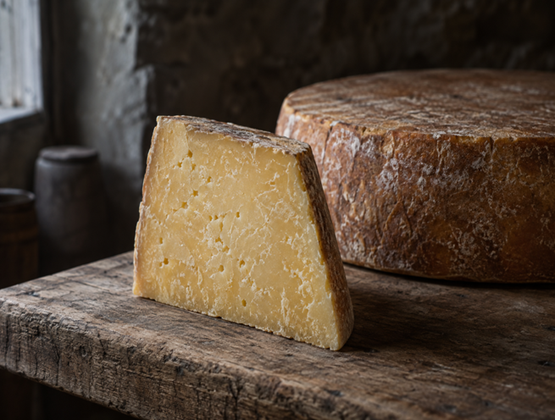
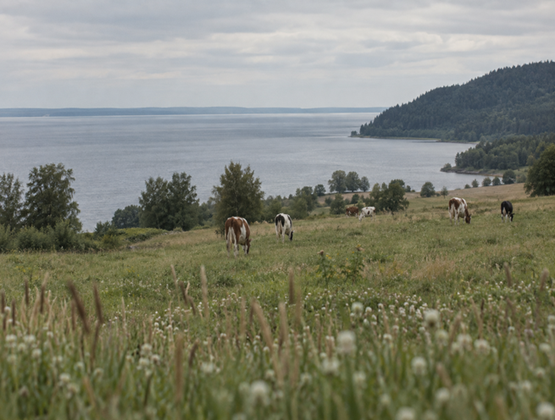
The country’s most iconic PDO comes from Västergötland, in south-west Sweden. It is called Wrångebäcksost and its production area is known as Guldkroken, literally ‘the golden hook’. According to the product sheet published by Smaka Sverige, the knowledge portal of the Swedish Board of Agriculture (Jordbruksverket), it is a narrow strip of land around the town of Hjo, wedged between Lake Vättern and the wooded hills of Hökensås.
This geographical layout explains the name. The area’s mosaic of soils supports a varied range of pasture flora, and Lake Vättern moderates the climate, making it milder than in the surrounding areas. The cows are put out to pasture from mid-April to mid-October, during which time they graze mainly on grass and meadow plants such as white clover and timothy grass. The link between the milk and the locality – the very heart of any PDO – is based here on a microclimatic difference measurable over a range of a few tens of kilometres.
A set of specifications governing the cheese from milk to maturing
Wrångebäcksost is a pressed cheese made from thermised organic milk, i.e. milk heated to a temperature lower than that used for pasteurisation. The milk comes mainly from Swedish lowland cattle (Svensk låglandsboskap), Brown Swiss and crosses between the two. The only permitted additives are calf rennet, specified starter cultures and table salt.
The wheels weigh between 8 and 13 kilos and must be matured for at least nine months. During the first three weeks, they are turned daily. The rind is washed with brine throughout the maturing process, which encourages the growth of surface cultures, particularly the red moulds that develop the cheese’s aroma and smell. An organoleptic assessment is carried out at six months, then at ten months, to evaluate the colour, smell, texture and taste.
The application was submitted by the Ost från Guldkroken association. The European Commission published its decision to register the cheese as a Protected Designation of Origin on 13 May 2022. The general principle behind these designations, now governed by Regulation (EU) 2024/1143, is outlined by Livsmedelsverket: for a PDO, the production of the raw material, processing and manufacture must all take place within the defined area.
Almnäs Bruk AB, a farm documented since 1225
Wrångebäcksost is produced by Almnäs Bruk AB, in Västergötland. The estate is first mentioned in a letter appended to the old law of Västergötland, dated 14 August 1225, which describes the demarcation of land by the monks of Alvastra Abbey. The estate has been owned by the Berglund family since 1915.
The figures give an idea of the scale of the operation: a total of 3,581 hectares, comprising 1,985 hectares of woodland and 1,031 hectares of arable land and pasture, with all agricultural activity certified to KRAV, the Swedish organic standard. The herd comprises around 500 head of cattle, including 180 dairy cows. The processing facility also produces Almnäs Tegel, Anno 1225 and Almnäs 1 Liter.
The history of this cheese is well worth a closer look. As the farm explains on its page dedicated to cheese, the ‘Wrångebäck Sweden’ mark, stamped on the side of each wheel, was registered on 8 April 1889, making it Sweden’s oldest registered cheese brand. Production ceased in 1961. Production resumed forty-seven years later thanks to Hans Stiller, a former cheesemaker at the estate who was then aged 82, and who recreated the recipe.
The maturing boards from the old dairy were reused to transfer the bacterial cultures still present in the wood, ensuring, according to the farm, microbiological continuity spanning at least one hundred and fifty years. Almnäs Bruk AB presents Wrångebäcksost as the first Nordic cheese to be awarded PDO status, and notes that it won a Silver Award at the 2018 World Cheese Awards in Bergen.
On the palate, it has the profile of a long-aged pressed cheese: a slightly lactic aroma, a complex flavour underpinned by umami, and a melt-in-the-mouth texture punctuated by crystals. The producer matures its wheels for ten to fifteen months, exceeding the regulatory minimum.
Kaffeost, the country’s second PDO, is enjoyed in a cup
Sweden’s second cheese designation of origin arrived much more recently and comes from the other end of the country. In June 2025, Kaffeost was granted a Protected Designation of Origin, as announced by Livsmedelsverket. Its production area covers the northern provinces of Norrbotten, Västerbotten, Lapland, Jämtland, Härjedalen and Ångermanland.
It is a fresh cheese, made from cow’s, goat’s or reindeer’s milk. After renneting and partial draining, it can be baked, salted or smoked to improve its shelf life. Its name derives from its traditional use: cut into cubes and dipped into boiling coffee, it softens, absorbs the drink’s flavours and is eaten with a spoon.
According to Eldrimner, the Swedish National Centre for Artisan Food, six producers were making this cheese at the time of registration. It is a culinary curiosity in its own right, and an excellent conversation starter at a cheese counter.
Two PGIs round off the Swedish dairy map
Alongside the two PDOs, Sweden protects two cheeses under Protected Geographical Indication status. Svecia, already mentioned, is a pressed cheese made from pasteurised cow’s milk, recognisable by its numerous fine holes. Its distinctive production method involves salting the curd rather than using brine or surface salting, and its rind is often waxed. A wheel measures 35 centimetres in diameter and weighs between 12 and 15 kilos. Two months’ maturing is sufficient, but Smaka Sverige emphasises that a longer maturation period significantly enhances its flavour.
More recently, Sörmlands Ädel was registered as a Protected Geographical Indication on 15 March 2023. This blue cheese made from cow’s milk is produced by Jürss Mejeri using organic whole milk from three Swedish breeds, in the province of Södermanland. The designation stipulates that grazing, milk production, production and maturing must all take place within the historic landscape, making it a PGI with a particularly restricted scope. The cylindrical wheels weigh around three kilos.
What Sweden brings to a dairy selection
For a cheese merchant or a retail buyer, these products will never sell in large volumes. Their appeal lies elsewhere: they are out of the ordinary and each has a story to tell. A cheese platter featuring a thermised pressed cheese from Lake Vättern, an organic blue cheese from Södermanland and a cheese designed to be dipped in coffee will catch the eye of a customer who has already tasted everything on offer in France and Italy. Three unknown products, each with its own story, and selling points that meet current expectations regarding origin, organic production and a connection to the local terroir.
These products provide a useful complement to the previous stages of the tour of Europe, from Portugal to Austria. Each country has a slightly different conception of the link between milk and its place of origin.
You’ll find these European producers, recognised by their quality labels, amongst the exhibitors at the next edition of the Cheese and Dairy Products Show, taking place from 11 to 13 June 2028 at Paris Expo Porte de Versailles for its anniversary edition.