ONE COUNTRY, ONE PAVILION

Exhibiting at the Cheese and Dairy Products Show means meeting cheesemongers, retail buyers and importers from across Europe over the course of three days. For a family-run cheese dairy entering the French market for the first time, this involves a great deal of preparation: booking a space, designing a stand, organising refrigeration logistics and arranging meetings. The national or regional pavilion makes it possible to share this organisational workload.
A collective organisation manages participation on behalf of a country or region. This may be a government export promotion agency, an industry association or a consortium of producers. The companies it selects set up within the space as co-exhibitors, with their products and sales teams.
Four Irish cheese producers under one banner
In 2026, the Bord Bia pavilion brought together four companies. Aileen Dautry explains their aims: “They are looking for new partners and new customers, but they are also here to reconnect with their existing customers, both French and from other countries.”
Their profiles are varied. Cashel Farmhouse Cheesemakers, founded in 1984 by Louis and Jane Grubb and now run by the second generation, produces Cashel Blue made from cow’s milk and Crozier Blue made from sheep’s milk. Knockanore Farmhouse Cheese, in County Waterford, makes raw-milk cheddar-style cheeses using milk sourced exclusively from the Lonergan family’s herd.
The Maher family produces Cooleeney Farmhouse Cheese in County Tipperary, including soft and hard cheeses made from cow’s and goat’s milk. Finally, Traditional Cheese Company, a family-run business established in 1984 in Dublin, cuts, waxes and packages cheeses for distribution, including under private label.
A single stand thus brings together a farmhouse blue, a raw-milk cheddar, soft cheeses and a packaging specialist. For a buyer, this offers a snapshot of a country’s range within a few metres. That is the whole point of the national pavilion.
Grass: the hallmark of Irish milk
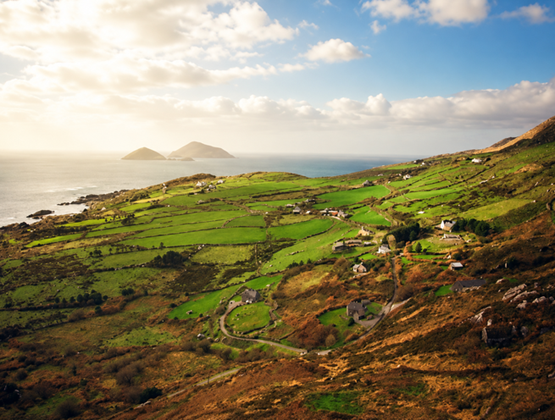
The second point relates to the families. “Many families work together on these farms, producing cheese and exporting it all over the world.” The grassland system and the families behind it make these cheeses unique,” continues Aileen Dautry.
The Bord Bia buyers’ guide lists around 17,000 family-run dairy farms in Ireland.
A model shared by other countries
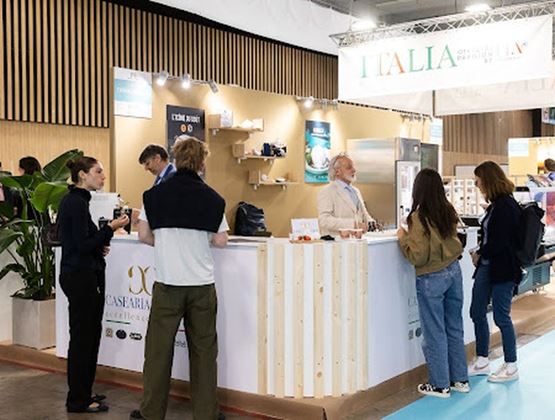
Its terms of reference clearly illustrate how a national pavilion operates. For 2026, the agency has allocated a space of approximately 114 m² for a collective of around nine companies. It covers the cost of the venue hire, the fitting-out of each stand, a refrigerated display cabinet, reception services and entry into the trade fair catalogue. In return, the products must be of Italian origin and a decision-maker from each company must be present throughout the fair.
The Italian Trade Agency applies the same format to SIAL Paris 2026, Djazagro, Gourmet Selection and other trade fairs.
Other countries are following suit. At the 2026 edition, several pavilions were shared between the Cheese and Dairy Products Show and Gourmet Selection, which were held simultaneously, notably those of Italy, Denmark and Spain. As early as 2022, Spain had already grouped half of its exhibitors under the pavilion of ICEX, the Spanish export promotion agency.
A format that benefits both exhibitors and buyers
For producers, the benefit is primarily practical. The organising body takes charge of the organisation, the stand layout and part of the promotion. Producers benefit from a strong national identity and a presence within a collective that naturally attracts buyers interested in that country. For a cheese producer entering the French market for the first time, it is also a way of testing the waters before eventually considering a stand of their own.
For visitors, the national or regional pavilion simplifies market research. A dairy retailer looking for a blue cheese or farmhouse cheddar, a supermarket buyer or an importer can meet several producers from the same country in one place. They can compare styles, available volumes and logistical conditions in a single visit.
Preparing for a collective participation in 2028
The next anniversary edition will take place from Sunday 11 to Tuesday 13 June 2028 at Paris Expo Porte de Versailles. For a promotional agency, an inter-professional organisation or a producers’ group, planning begins early. They need to select the companies, determine the floor space and prepare the joint marketing campaign.
The stand options and the good reasons to exhibit provide an initial framework, and the trade fair’s sales team supports this type of collective project.
As for Aileen Dautry, she admits that it is easier for her to name her favourite Irish cheese. But if she had to choose a French cheese, it would be “a Comté, perhaps matured for 18 months”. An answer which shows, in its own way, that the Paris trade fair remains a place for exchange between cheese-making cultures.
Image credit:
Nils Nedel - Unsplash