THEY SUPPLY DAIRY AND CHEESE SHOP OWNERS

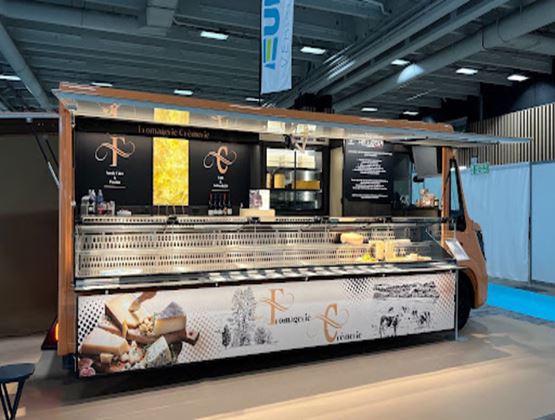
A manufacturer of commercial vehicle bodies amongst the cheese affineurs
Euromag’s target clientele overlaps exactly with the trade fair’s visitors. “Mainly cheese sellers and dairy farmers, as well as farmers who process their own produce and manufacture their own goods – everyone involved in the cheese industry,” explains Samuel Jaubert. Farmers selling directly to the public, market cheese merchants, and mobile traders in rural areas: all these professionals rely on vehicles as their tools of the trade, which are replaced every seven to ten years.
Refrigeration: the top priority expressed by customers
When asked about market trends, the director immediately identifies a priority. “Particularly when it comes to refrigerated storage: with summers getting hotter and hotter, there’s a demand for cooling – and for high-quality cooling.” This is not merely a perception. According to Météo-France, two-thirds of the heatwaves recorded in France since 1947 have occurred since the start of the 21st century, and half of these since 2010. The public body also notes that these episodes now occur earlier in the season – as early as mid-June nationwide – and later, after 15 August.
For a cheese retailer, the challenge is also a legal one. The decree of 21 December 2009, which sets out the health regulations applicable to the retail sale, storage and transport of products of animal origin, stipulates a maximum temperature of 4 °C for raw milk intended for consumption as is, and leaves the storage temperature for matured cheeses and pasteurised milk to the discretion of the manufacturer or packager.
The same decree sets the storage temperature for highly perishable foodstuffs in direct-sale outlets at 4 °C, and for other perishable foodstuffs at 8 °C. Maintaining these temperatures for several hours on a display stand exposed to the sun during a heatwave is not simply a matter of fine-tuning the settings. This is precisely where the difference between two vehicles lies.
A wall-mounted display case designed to prevent condensation
Euromag has therefore focused its recent developments on this dual requirement of cooling and visibility. “We are introducing a new wall-mounted display case that allows the products behind it to be showcased, with lighting and refrigerated storage,” explains Samuel Jaubert.
The company has also tackled a problem all too familiar to market traders: misting. “We’ve also put a great deal of effort into tackling condensation to prevent it from occurring on rainy days,” adds the director. In damp weather, condensation builds up on the glass, obscuring the products from customers’ view. This sort of fine-tuning – which isn’t visible on a technical specification sheet – is carried out in the workshop and tested under real-world conditions. The range of trades brought together at Euromag – from the design office to bodywork, via electrical work and tailoring – is justified by this level of finish.
Enhancing an everyday trade
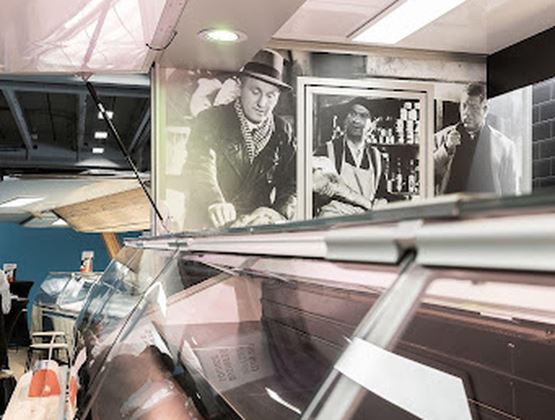
This concern is shared by all the solution providers present at the trade fair. The ‘Equipment and Machinery’ sector counts amongst its registered exhibitors for 2026 specialists in the manufacture of mobile retail units, refrigeration equipment, fit-outs for dairy and cheese shops, cutting and weighing, packaging and labelling, payment solutions and even professional textiles. Bizerba, also an exhibitor, offers cheesemakers a range of solutions covering cutting, processing, weighing, packaging and labelling.
More ergonomic equipment to tackle labour shortages
A third, more structural issue is emerging from the field and reaching the workshops. “With summers getting hotter and hotter, we’re trying to work in better conditions, and there’s also the difficulty of finding people to work at the markets; so we’re trying to ensure our equipment is as ergonomic as possible to help them in their day-to-day work.”
Ergonomics is thus becoming a selling point in its own right, on a par with refrigeration capacity. Worktop height, accessibility to storage areas, room for two people to move about in a 6-metre unit: every centimetre gained translates into less fatigue during a market day that begins before dawn. For the retailer, this is a partial solution to a labour equation that no one in the sector can solve on their own.
A mobile shop doesn’t sell itself from a catalogue
There remains the question that equipment manufacturers legitimately ask themselves before booking a stand: why exhibit at a trade fair dedicated to cheese when you don’t sell cheese? Samuel Jaubert answers this straightforwardly.
“What we really enjoy is showing our products to our customers – the cheese retailers – so they can touch them, climb inside the units, have the new products presented to them, and above all, chat with them in a friendly atmosphere.” A mobile shop isn’t something you sell from a catalogue. You have to see it, compare it, discuss it whilst standing there, a hand on the display window.
Other exhibitors who do not sell cheese
Euromag is not an isolated case. Of the five worlds that make up the exhibition’s offering, three do not focus on cheese itself.
The ‘Complementary Products’ section brings together jams and honeys, gingerbread and speciality breads, spices and condiments, ready meals and cheese specialities, vinegars, sauces and drinks. The ‘Services, Professional Organisations and Press’ section brings together trade unions, certification bodies and associations, the specialist press and publishing houses, communications agencies, banks, insurance companies and pension funds, consultancy firms specialising in organisation, logistics and IT, as well as transport providers. Three categories of exhibitors, all sharing the same approach: supporting the product without manufacturing it.
See you on 11, 12 and 13 June 2028
The 20th edition of the Cheese and Dairy Products Show will take place from Sunday 11 to Tuesday 13 June 2028 at Paris Expo Porte de Versailles.