CHEESE ART: WHEN CHEESE BECOMES A WORK OF ART

Cheese art encompasses all the techniques that turn cheese into a visual object as much as a product to be tasted. Rind engraving, knife carving, trompe-l’œil, novel shapes, and artistically arranged platters: the forms are many, but the intention remains the same. Even before tasting, the cheese must catch the eye and whet the appetite. This creativity is now evident at every level of the industry. Cheese retailers use it as a tool for in-shop promotion. Producers design their cheeses as genuine elements of visual identity. And in professional competitions, artistic flair is what sets the contestants apart.
A Gothic rose window engraved into a black rind
The most talked-about recent example comes from Lyon. Cheesemonger Thomas Bertrand carved the rose window of the Saint-Jean Primatial Basilica, a Gothic gem in Vieux Lyon, into the rind of a wheel of Saint Romain, a creation by Maison Mons washed with Gamay marc extract. The black rind traces the stonework. The pale cheese, revealed by the incision, acts as the glass.
The idea did not come from the world of cheese, but from pastry-making. Lyon-based chef Thomas Dura had reproduced this very same rose window on his praline tart, crowned world champion at the 2025 Mondial de la Praline, as reported by Tribune de Lyon. Thomas Bertrand says as much himself on LinkedIn: what a pastry chef does with sugar, a cheesemaker can do with the rind. And his creation is ephemeral. It is sold, sliced and eaten. The work does not last. It is transformed into conversations, tastings and sales.
An art practised on a massive scale
Cheese art is neither a recent invention nor exclusive to Europe. In the United States, cheese carving has been a tradition at agricultural fairs for decades. The sculptor Sarah Kaufmann, nicknamed ‘The Cheese Lady’, has been carving 290-kilo blocks of cheddar supplied by cheese dairies for over twenty years, according to the American public radio station NPR. At the Indiana State Fair, her sculpted mural depicting the history of the American dairy industry weighed 420 kilos – nearly half a tonne of cheddar – carved over the course of a week with three assistants, in full view of the public.
The anecdote may raise a smile, but the business behind it is serious. These sculptures are commissioned by dairy associations and retailers for one simple reason: they attract crowds, generate buzz and turn cheese into a spectacle. Cheese art, on every scale, is first and foremost a tool for attracting attention.
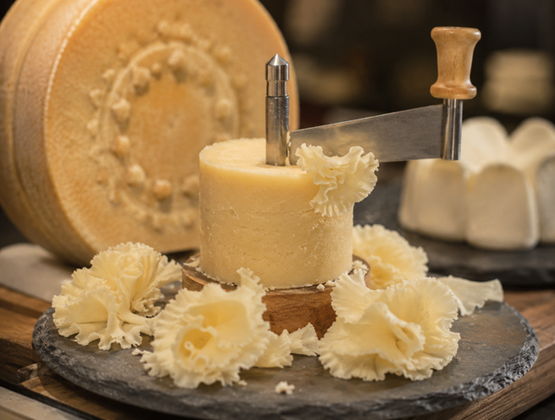
The ‘girolle’, or when shape makes a cheese take off
The product itself had not changed. Its serving form, however, had. The success was so great that producers adapted the shape of the wheels – now cylindrical and straight – to better suit the utensil, as noted by Swiss Culinary Heritage. The rosette has turned every tasting into a little spectacle, both in the shop and at the table. Forty years on, this lesson remains the cornerstone of ‘cheese art’: shaping creates value.
Cheeses designed as works of art right from the production stage
Some producers now incorporate this visual dimension right from the design stage. The winners’ list for the Coups de Cœur Competition 2026 at the Cheese and Dairy Products Fair provides two striking examples, among the ten award-winning cheeses this year following a blind tasting conducted by 25 international experts. The details of the 2026 winners illustrate the diversity of the award-winning styles.
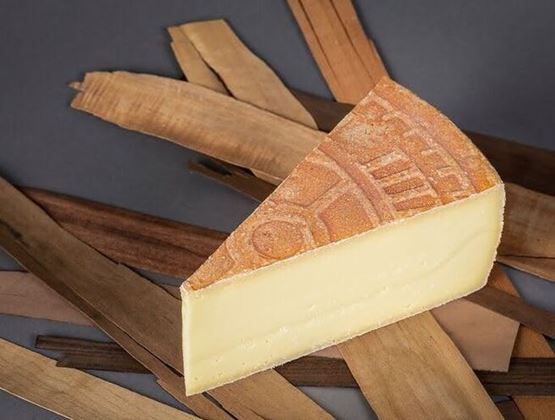
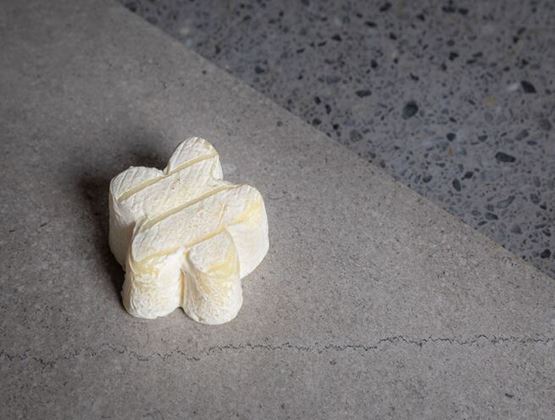
In both cases, the shape is not merely a decorative feature. It is an integral part of the product, its history and its price. It provides the cheesemonger with a story ready to be told.
Emotion sells before taste
Why does this visual aspect carry so much weight? Because in the food retail sector, everything is often decided in a matter of seconds – and by what the eyes see. Research confirms this. A study by the University of Oxford published in the journal *Flavour* served the same dish to three groups of diners, in three different presentations. The result: when the ingredients were arranged artistically, inspired by a Kandinsky painting, participants rated the dish as better and were willing to pay £5.94 instead of £4.10 for the standard version – nearly 45 per cent more. The product was identical. Only the presentation had changed.
Retailers see this in action every day. In a survey on the in-store experience, Speciality Food Magazine describes the direct impact of counter dramatisation on sales. At the cheese and dairy shop George & Joseph in Leeds, founder Stephen Fleming observes this every week. A piece of Gorgonzola Dolce placed on the counter, served by the spoonful from its open form, triggers a chain reaction of purchases. The next customer in the queue asks for the same thing as the one before.
The logic is the same from producer to retailer. The customer isn’t buying a flavour first and foremost. They’re buying an emotion, a sense of curiosity, a story to tell at the dinner table. For a product whose price per kilo far exceeds that of the self-service section, this emotion isn’t an extra. It’s essential to the sale.
Staging your counter, on every scale
Not everyone will carve a Gothic rose window or mould a clock face into a rind. The good news is that the mechanics of ‘cheese art’ work at every level. The survey by Speciality Food Magazine of retailers such as George & Joseph or La Fromagerie in London provides the full spectrum.
Cutting the cheese in full view remains the most accessible technique. Simply cutting into a wheel in front of the customer is already a spectacle in itself. The rinds also deserve to be showcased. All you need to do is play on contrasts of shape and colour in the display case, and present the whole pieces before cutting. The cut pieces, for their part, reveal what the packaging hides: a runny centre, blue veins, or a particular texture. Finally, Patricia Michelson, founder of La Fromagerie, recommends organising the display by theme. A season, a region or a family of cheeses is enough to transform a counter into a narrative.
Thomas Bertrand himself is exploring other formats. He has devised a cheese Rubik’s Cube, showcased at Mons Fromager in Lyon. The concept can be summed up in a single sentence: 27 hand-assembled cubes, three cheeses, three pairings, and the customer creates their own bite-sized combinations. Tasting becomes a game. None of these ideas requires the skill of a sculptor. All require the same conviction: the shop is a stage, and cheese is the star of the show.
From the counter to the show
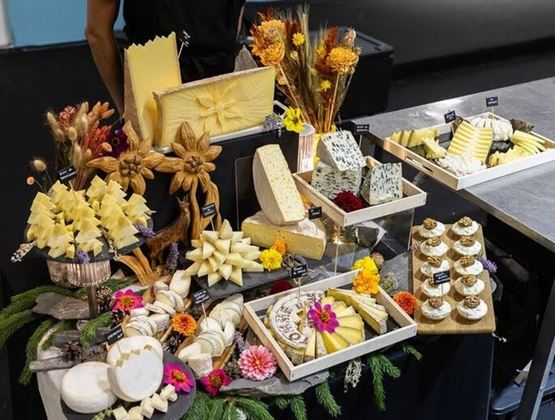
The 2026 Lyre d’Or Competition, organised by the Union des Fromagers d’Île-de-France, provided further proof of this, with a round entirely dedicated to cheese trompe-l’œil. Thomas Bertrand was among the twelve finalists, entering as an independent candidate, with a platter of eight raw-milk cheeses named ‘Le Chemin des Terroirs’. His trompe-l’œil earned him a special mention from the jury, one of three awarded this year. The Lyre d’Or went to Bérenger Bottagisi, from Fromagerie Janin in Champagnole, as reported by the Fédération des Fromagers de France. One detail of his entry is particularly noteworthy. According to HERE, his sculptures and designs carved into the Comté cheese with a knife helped to win over the jury. Cheese art can therefore also lead to competition wins.
The Cheese and Dairy Products Show brings together, every two years, the producers, affineurs and retailers who embody this high standard.
The next edition will mark the show’s 20th anniversary, taking place from 11 to 13 June 2028 at Paris Expo Porte de Versailles. Three days to meet producers, discover the creations that will be the talk of the town, and leave with practical ideas for your counter – because cheese is first and foremost sold to the eye, and the desire to buy it arises before tasting.