
SUMMER CHEESES IN THE SPOTLIGHT

Summer is the season of abundance and conviviality. The sunny meadows provide a generous supply of milk, which is made into cheeses with supple pastes, well-defined flavours and floral or fruity flavours. Summer platters are made up of fresh or matured items, perfect for picnics, salads or time shared with family and friends. The markets come alive with bright colours and sun-drenched produce, and every platter invites us to enjoy a little summer indulgence.
Fresh cheeses and classic mountain varieties coexist in harmony, providing a panorama of textures and bright flavours. This is also the time to pair cheeses with sun-kissed fruit, grilled vegetables and light rosé wines.
Summer celebrates the diversity of the terroirs, the wealth of expertise and the pleasure of simple, joyful tasting, every mouthful reflecting the season’s warmth, light and generosity.
Longer summer evenings mean we can take our time over shared platters, accompanied by a glass of chilled wine or a light beer, while the cheeses reveal all their freshness and natural flavour. Summer is a time for indulgence and freedom, where cheese can be enjoyed in a happy, relaxed atmosphere.
CHEESES IN THE SPOTLIGHT
- Abondance AOP – Auvergne-Rhône-Alpes
- Bleu d'Auvergne AOP – Auvergne-Rhône-Alpes
- Bleu du Vercors-Sassenage AOP – Auvergne-Rhône-Alpes
- Brie de Meaux AOP – Île-de-France et Grand Est
- Brousse du Rove AOP – PACA
- Cancoillotte IGP – Bourgogne-Franche-Comté
- Chevrotin AOP – Auvergne-Rhône-Alpes
- Emmental de Savoie IGP – Auvergne-Rhône-Alpes
- Langres AOP – Grand-Est
- Picodon AOP – Auvergne-Rhône-Alpes
- Reblochon AOP – Auvergne-Rhône-Alpes
- Sainte-Maure de Touraine AOP – Centre-Val-de-Loire
- Saint-Nectaire AOP – Auvergne-Rhône-Alpes
- Tomme de Savoie IGP – Auvergne-Rhône-Alpes
Somme european neighbours
- Gorgonzola AOP – Italie, Lombardie / Piémont
- Ricotta – Italie, Sicile, Calabre, Campanie
- Queso Mahón-Menorca AOP – Espagne, Baléares
- Queso San Simón da Costa AOP – Espagne, Galice
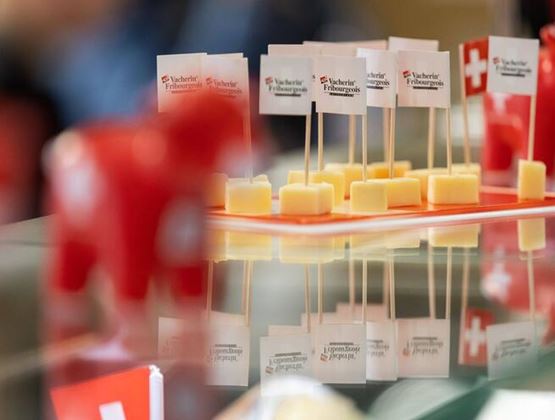
SPOTLIGHT ON EMMENTAL DE SAVOIE IGP
Pressed cooked cheese
History and origin
Emmental de Savoie comes from the French Alps and differs from its Swiss cousin in that it is produced locally and the wheels are smaller. Its history dates back to the 19th century, when Savoy cheesemakers adapted Swiss know-how to local resources. The IGP label was obtained in 1996, guaranteeing the origin and quality of this emblematic cheese. Its blond paste, with its regular holes, bears witness to well-controlled mixing and fermentation.
An anecdote
In the past, Emmental de Savoie was a key ingredient in “mountain pasture meals”: shepherds used to eat it with their bread to keep them going all day in the mountains.
A tasting tip
Perfect in a toasted sandwich, gratins or on a fresh summer platter.
How to cut
Thinly sliced, or in even-sized cubes for platters.
Seasonality and trade secrets
The raw milk is curdled, heated and pressed in large moulds. Maturation lasts a minimum of 75 days, allowing the cheese to develop its fruity flavours and melt-in-the-mouth yet firm texture. The wheels are turned and brushed regularly to ensure even maturation.
Suggested pairings
- Wine: dry white wine from Savoie (Apremont, Roussette)
- Bread: seeded or farmhouse bread
- Fruit: melon, white grapes, figs
- Serve with: light cold cuts, walnuts, green salad, apple compote
SPOTLIGHT ON REBLOCHON PDO
Pressed uncooked cheese
History and origin
Reblochon is a historic cheese from Haute-Savoie, whose name comes from re-blocher, “to milk a second time”. This practice enabled farmers to pay less tax on the first milking while producing richer milk for cheese. Produced since the 13th century, it obtained its AOC in 1958. Reblochon’s reputation has grown with Savoyard recipes, tartiflette in particular.
An anecdote
Although tartiflette became popular in the 1980s thanks to a producers’ union, Reblochon has existed for centuries and was historically eaten by local farmers for its nutritional qualities and mild flavour.
A tasting tip
Ideal in summer on toast, accompanied by a cream of beetroot, a few hazelnuts and arugula for a perfect balance.
How to cut
In triangular wedges to balance the paste and rind, like a Camembert.
Seasonality and trade secrets
Although it is often associated with winter dishes such as tartiflette or croziflette, the full flavour of Reblochon comes out when the warmer weather arrives. Made from the raw milk of Tarine, Abondance or Montbéliarde cows, it is produced mainly in spring and summer, when the pastures are full of fresh grass and flowers. Lightly pressed and then matured for 15 to 30 days, its paste develops an orange-coloured rind and slight bloom. The more flavourful the milk, the more aromatic and creamier the cheese, ideal for fresh, fruity pairings in the summer months.
Suggested pairings
- Wine: white wine from Savoie (Apremont, Chignin-Bergeron), red wine from Jura, sweet or dry cider
- Bread: sourdough bread, sesame baguette, farmhouse bread
- Fruit: apricots, mirabelle plums, blueberries
- Serve with: hazelnuts, beetroot, marinated peppers
SPOTLIGHT ON BLEU D’AUVERGNE PDO
Marbled paste
History and origin
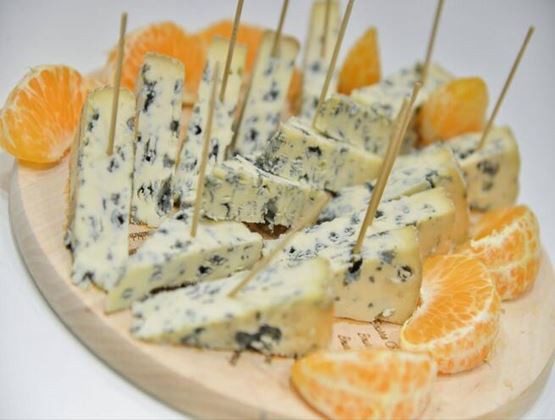
Bleu d’Auvergne is one of France’s oldest blue-veined cheeses, created in the 19th century by Antoine Roussel, who wanted to compete with Roquefort. Made from raw or pasteurised cow’s milk, it has a soft, slightly crumbly texture and well-defined blue veins. The AOC was obtained in 1975, guaranteeing its traditional production method and Auvergne origin.
An anecdote
In the past, Auvergne farmers considered that a heavily veined Bleu was a good omen for their herds and crops.
A tasting tip
Ideal on summer salads, in a pasta sauce, or melted over grilled mixed vegetables. How to cut Thickly sliced or in small pieces for dishes and platters.
Seasonality and trade secrets
It is produced all year round, although the spring and summer milk yields cheeses that are richer in flavour. The milk is curdled, cut, and injected with Penicillium roqueforti. Maturation in damp cellars lasts from 4 to 8 weeks. Perforations allow air in, activating the blue mould in the paste.
Suggested pairings
- Wine: sweet white wine (Coteaux du Layon, Gewurztraminer) or light red wine (Côtes d’Auvergne)
- Bread: walnut bread or wholemeal bread
- Fruit: pears, figs, kumquats
- Serve with: walnuts, honey, mild cold cuts, aubergine
Discover summer cheeses at the Cheese and Dairy Products Show
Beyond summer tastings, these cheeses form part of the range brought together at each edition of the Cheese and Dairy Products Show. The event brings together producers, affineurs and cooperatives in dedicated sections showcasing French cheeses (including AOP and IGP), foreign cheeses, butters and other dairy products, as well as accompaniments – essentially everything you’d find on a summer cheese platter.
The programme further highlights these regional specialities through its key events: the Coups de Cœur Competition, the Lyre d’Or Competition, the Grilled Cheese Challenge, not to mention the tasting workshops and talks at the Expert's Agora – all providing opportunities to understand how to work with these cheeses throughout the seasons.
The 20th edition will take place from 11 to 13 June 2028 at Paris Expo Porte de Versailles. Until then, the Guide to Cheese Seasonality remains the ideal companion for putting together seasonal platters month by month and bringing summer to life in the cheese shop.