
COOKED-PRESSED CHEESES: THE FAMILY OF LARGE, AGED WHEELS

The quintessential long-ageing cheeses pressed cooked cheeses are recognised by their large wheels and their ability to age for months, sometimes years. Their identity lies neither in the rind nor in the terroir, but in a precise production technique: heating the curd grains to over 50 °C, followed by vigorous pressing that removes moisture and densifies the paste.
Heating the curd and pressing: the technique that defines the family
After renneting, the curd is cut into fine grains, the size of a grain of rice, then heated – a process also known as ‘cooking’ – to a temperature of between 53 and 56 °C depending on the appellation, before being pressed to expel as much whey as possible. This cooking of the curd distinctly sets this family apart from its neighbour, the uncooked pressed cheeses, whose curd is not heated beyond around 40 °C and which retain a moister and more supple texture. The result is a dense paste, firm at first but then melting in the mouth, with low moisture content, capable of being kept for a very long time. It is precisely this ability to keep well that, from the Middle Ages onwards, justified the production of large wheels and the organisation of producers into co-operatives – known as ‘fruitières’ – where milk from several herds was pooled to make a single cheese. This family is also historically known as the ‘Gruyère’ family, named after the great mountain cheese that serves as its model.
Three mountain PDOs: Comté, Beaufort and Abondance
The exhibition’s classification lists three French Protected Designations of Origin (PDOs) within this family. The Comté PDO is the flagship of the group: made from raw milk from Montbéliarde and French Simmental cows in the Jura region (Doubs, Jura, eastern Ain and a few neighbouring communes), it comes in wheels weighing between 32 and 45 kilos, the curd of which is heated and stirred at 53°C for at least thirty minutes before pressing. According to the Ministry of Agriculture, it has held an AOC designation since 1958 and a PDO designation since 1996, and it takes around 400 litres of milk to make a single wheel.
Beaufort PDO, nicknamed the ‘prince of Gruyères’, is recognisable by its concave heel, achieved using the traditional wooden mould known as the ‘Beaufort mould’. Produced in the high valleys of Savoie (Beaufortain, Tarentaise, Maurienne and part of the Val d’Arly) from raw whole milk from Tarine and Abondance cows, it comes in three varieties: Beaufort, Beaufort d’été and the rare Beaufort Chalet d’alpage, made at altitudes above 1,500 metres using milk from a single herd. Its specification, one of the strictest in the sector, can be viewed on the INAO website and stipulates a minimum maturing period of five months.
The third designation in the family, Abondance PDO occupies a technical middle ground: its curd is heated to an intermediate temperature, in the region of 45 to 50 °C, which is why it is often described as a ‘semi-cooked’ or ‘half-cooked’ cheese. Produced in Haute-Savoie around the Chablais region using Abondance, Tarine and Montbéliarde breeds, it takes the form of a small wheel weighing around ten kilos with a concave heel, matured for at least one hundred days on spruce boards, as noted by the Ministry of Agriculture. In addition to these designations, under the Protected Geographical Indication (PGI) scheme, there are Emmental de Savoie PGI and Gruyère de France PGI, which extend this tradition beyond the scope of PDOs.
Comté, France’s leading cheese designation
It is difficult to discuss this family of cheeses without acknowledging its economic significance. Hard-pressed, cooked cheeses account for the largest volume of all French cheeses bearing a quality label: according to the key figures for PDO and PGI dairy products published by the INAO and the CNAOL, the category totalled over 71,000 tonnes sold, an increase of 19 per cent over ten years, with Comté alone accounting for 88 per cent of this. With around 61,000 tonnes sold in 2024 – equivalent to nearly 1.6 million wheels – Comté is France’s leading PDO cheese by volume, produced in some 150 dairy cooperatives by around 2,600 dairy farmers. This cooperative structure, which remains very much alive, explains why there is no industrially produced Comté. More broadly, France remains the European leader in dairy products with protected designations of origin, as highlighted by the CNAOL, and hard, cooked cheeses form one of the cornerstones of its culinary identity.
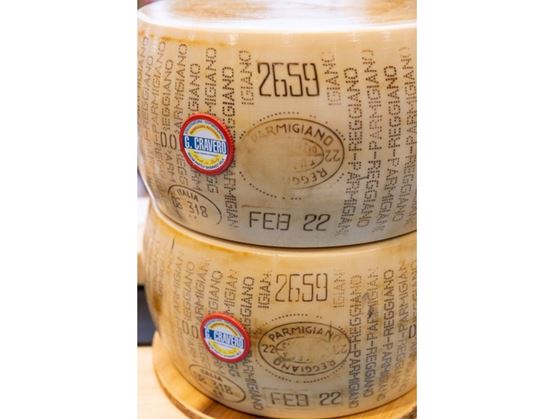
From Gruyère to Parmigiano, a family spanning Europe
Long maturation: a craft of expertise that is difficult to standardise
Whilst the production process gives the cheese its character, it is the maturation process that reveals the true quality of the cheese. The role of the maturer is central here: for months on end, the wheels are turned, rubbed, salted and monitored in cool, damp cellars, on spruce planks that develop their own unique flora. The longer the maturing process, the more complexity the cheese gains, until, in long-aged cheeses, tyrosine crystals appear that crunch between the teeth. For Comté, each wheel is marked out of 20 by a panel; the highest-scoring wheels receive a green band and are identified by a casein tag that ensures individual traceability. This artisanal expertise, which is difficult to replicate on a large scale, explains why these cheeses remain associated with a highly skilled workforce. Maturing techniques are, moreover, a regular feature on the programme of the trade show's conferences and tasting workshops.
In the kitchen: from fondue to a cheese platter, unrivalled uses
Few cheese varieties lend themselves to such a wide range of professional uses. On a cheese platter, Beaufort is served in thin slices rather than grated; Comté ranges from mild to fruity depending on the maturing process; and mature wheels of Parmigiano are broken into chunks. When heated, these cheeses melt evenly and hold their shape during cooking, making them the cornerstones of fondue, cheese crusts, gratins and soufflés, as well as grilled cheese sandwiches, which take centre stage at the Grilled Cheese Challenge. Savoyard fondue, in particular, remains the family’s most iconic dish, as noted in the exhibition guide, which highlights that Beaufort can be combined with Comté in this dish, or even used on its own to give it more character.
A seasonal recipe: fondue with Beaufort PDO and Comté PDO
Serves 4. Preparation: 15 mins. Cooking time: 15 mins. Cost: moderate.
Ingredients: 400 g Beaufort AOP, 400 g Comté AOP matured for 12 months, 1 clove of garlic, 25 cl dry white wine from Savoie (Apremont or Roussette), 1 teaspoon of cornflour, freshly ground black pepper, nutmeg, 1 stale country loaf.
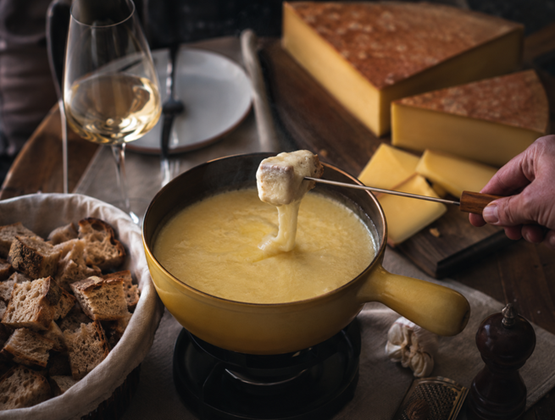
Method: Rub the inside of a fondue pot with the cut garlic clove, then pour in the white wine and heat gently without bringing to the boil. Cut both cheeses into thin slices and add them gradually, stirring in a figure-of-eight motion with a wooden spatula, until a smooth, creamy texture is achieved. Dissolve the cornflour in a tablespoon of cold wine, stir it in to thicken the mixture, then season with a twist of freshly ground pepper and a pinch of nutmeg. Keep over a very low heat and serve immediately with country bread cut into cubes. The balance between the fruity intensity of the Beaufort and the lingering finish of the matured Comté illustrates how well pressed-curd cheese holds its structure when heated.
Exhibitors at the Cheese and Dairy Products Show
The Cheese and Dairy Products Show brings together a rich array of national and international products, with nearly 300 exhibitors from 15 countries.
Several exhibitors showcase the diversity of expertise associated with pressed-curd cheeses, from production to long-term maturing. This selection is not an exhaustive list.
Join us at the Cheese and Dairy Products Show from Sunday 11 to Tuesday 13 June 2028 at Paris Expo Porte de Versailles, the unmissable event for industry professionals.