
WINTER CHEESES

Winter is the season of comforting flavours and rich textures. The more concentrated milk from wintering herds gives rise to strong pressed or soft cheeses, which can be enjoyed melted or on a platter. The cellars reveal their matured content with deep, complex aromas, perfect for long evenings and shared dining. Cheeses made from the rich summer milks and matured over the autumn reach their peak and make their way to festive tables, filling the room with their aromas and creating a warm atmosphere. Cooked cheeses, washed rinds and creamy cheeses go well with cold cuts, potatoes or winter stews, as a complement to traditional dishes.
It’s also the time for the great classics: raclettes, fondues, tartiflettes or gratins, where each cheese tells a story of patience and expertise. Pairings with full-bodied white wines, generous reds or festive bubbles add to the pleasure, making winter a season where warmth and sharing can be enjoyed with every mouthful. Winter invites us to enjoy time together, and "slow tastings", where each cheese is a promise of pleasure and comfort.
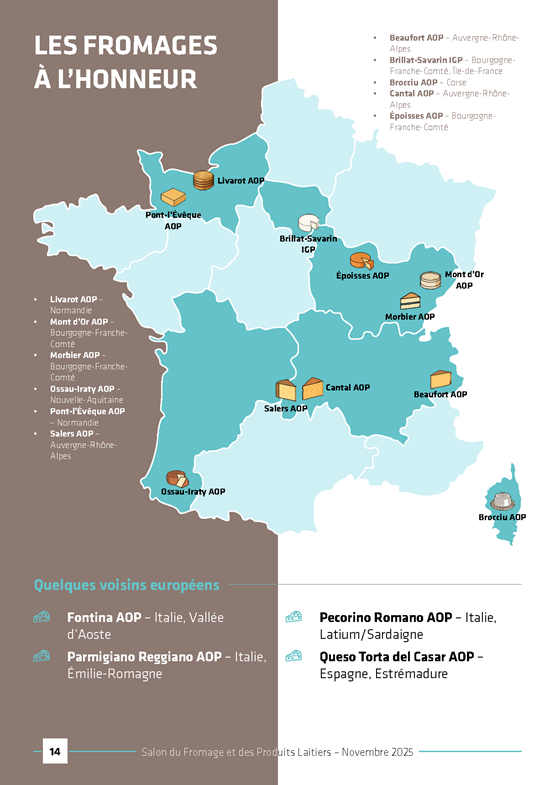
Cheeses in the spotlight
This winter season, discover the French cheeses that are in the spotlight:
- Beaufort PDO – Auvergne-Rhône-Alpesb
- Brillat-Savarin IGP – Bourgogne-Franche-Comté, Île-de-France
- Brocciu PDO – Corse
- Cantal PDO – Auvergne-Rhône-Alpes
- Époisses PDO – Bourgogne-Franche-Comté
- Livarot PDO – Normandie
- Mont d’Or PDO – Bourgogne-Franche-Comté
- Morbier PDO – Bourgogne-Franche-Comté
- Ossau-Iraty PDO – Nouvelle-Aquitaine
- Pont-l’Évêque PDO – Normandie
- Salers PDO – Auvergne-Rhône-Alpes
Some European neighbours
- Fontina PDO – Italy, Aoste valley
- Parmigiano Reggiano PDO – Italy, Emilia Romagna
- Pecorino Romano PDO – Italy, Lazio/Sardinia
- Queso Torta del Casar PDO – Spain, Extremadura
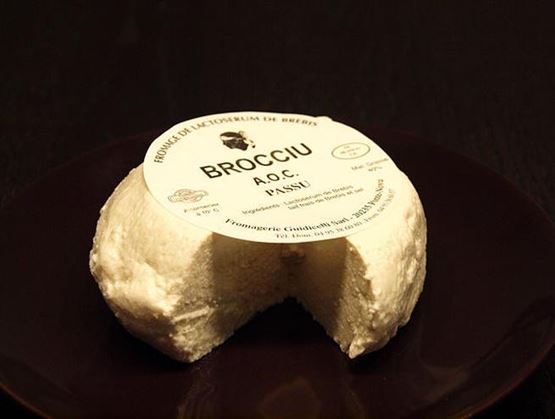
Spotlight on Brocciu PDO : Whey cheese
History and origin
Brocciu is considered Corsica’s ‘national cheese’. Its history is part of a deeply-rooted pastoral tradition on the island. It is made by adding whole milk to the whey from the manufacture of goat and/or sheep milk cheeses. This ingenious method meant the shepherds lost nothing of what they produced, making the most of every drop of milk. Its name comes from the Corsican verb brousser (to whip), in reference to the stirring of the curds. Awarded AOC status in 1983, Brocciu symbolises both a cultural identity and a gourmet product.
An anecdote
The poet Émile Bergerat once said that "anyone who hasn’t tasted Brocciu doesn’t know the island", proving it is an essential element in Corsican gourmet dining.
A recipe
An essential ingredient in Corsican specialities such as fiadone (Brocciu cake), it can also be enjoyed as a fromage frais; savoury (with salt, pepper and fresh herbs) or sweet (with honey, jam or sugar and citrus fruits).
How to cut
Spooned or thickly sliced, depending on its consistency.
Seasonality and trade secrets
Brocciu is a seasonal cheese: it is produced mainly from November to June, when the milk from Corsican sheep and goats is at its most abundant and flavourful. The whey is heated and the addition of the whole milk causes the solid matter to rise to the surface. The resulting curds are collected with a ladle and poured into traditional moulds. Brocciu can be eaten very fresh, just a few days after it is made. A slightly matured version, called Brocciu Passu, develops stronger flavours and a firmer texture.
Suggested pairings
- Wine: a Corsican white wine (Patrimonio, Vermentino)
- Bread: focaccia or corn bread
- Fruit: citrus fruits (clementines, oranges), fresh figs
- Serve with: honey from the maquis, fig Jam
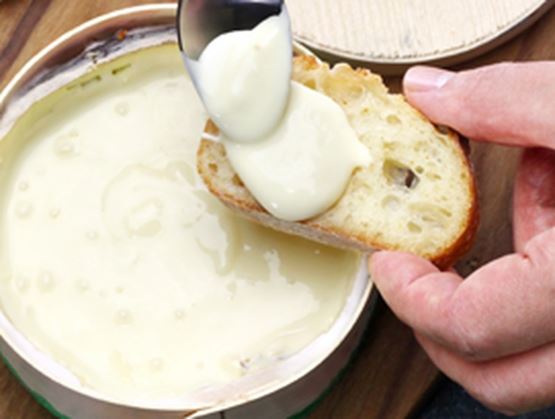
Spotlight on Mont d’Or PDO : Soft cheese with a washed rind
History and origin
The Mont d’Or, or Vacherin du Haut-Doubs, is produced in the Jura mountains. It was first made in the 18th century by farmers who, when winter came, no longer had enough milk to make the large wheels of Comté cheese. They created this smaller cheese, encased in spruce bark. The wooden strapping plays an essential role: it holds the cheese in place, giving it its shape and its characteristic woody flavour. The AOC was obtained in 1981, recognising this unique expertise.
An anecdote
The craftspeople who make the spruce straps used in the maturing process are nicknamed sangliers, a pun on ‘wild boars’ and sangle, the spruce strap. Their traditional skill is essential to the Mont d’Or.
A tasting tip
The classic: baked Mont d’Or. Make a small hollow in the rind, add a clove of garlic and a dash of Jura white wine, then bake in its box, gratin-style. Served hot and runny, it is shared like a fondue.
How to cut
Spooned straight from the box.
Seasonality and trade secrets
Mont d’Or is a strictly seasonal cheese: it is only produced from 15th August to 15th March, and available for sale from 10th September to 10th May. Made exclusively with raw milk from Montbéliard and Simmental cows, it is matured for a minimum of 21 days in its spruce box, developing its thin, wrinkled, slightly pink rind. The paste becomes supple, creamy, even runny, with subtle aromas of cream and resin.
Suggested pairings
- Wine: a Jura white (Savagnin, Chardonnay)
- Bread: multigrain bread or rustic baguette
- Fruit: steamed potatoes (classic), pears
- Serve with: smoked cold cuts, gherkins
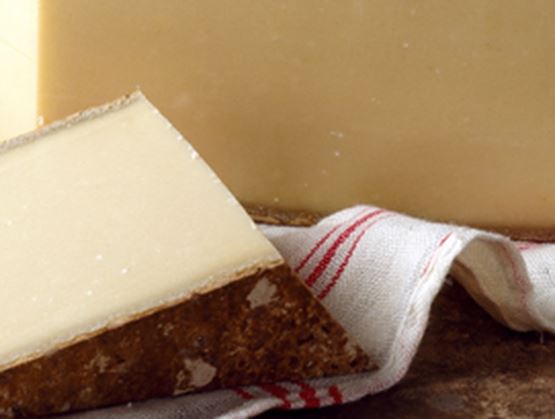
Spotlight on Beaufort PDO : Pressed cooked cheese
History and origin
Nicknamed the ‘Prince of Gruyères’, Beaufort is a Savoyard cheese that dates back to the Middle Ages. It takes its name from the Beaufortain massif in Savoie. Enjoyed from the Middle Ages onwards, it was a valuable commodity in regional trade. Its reputation was cemented in the 19th century when dairy cooperatives were formed. Obtaining the AOC label in 1968 officially confirmed its role as the jewel in the crown of Savoy gastronomy.
An anecdote
In bygone days, mules carried the wheels of alpage Beaufort down into the valley on mules, a laborious process that contributed to its reputation as a rare and precious cheese.
A recipe
This is one of the stars in Savoyard fondues. It is often mixed with Comté and Emmental, but a 100% Beaufort fondue has even more character!
How to cut
Thinly sliced, following the curve of the wheel, or in even-sized cubes for platters.
Seasonality and trade secrets
Made exclusively from the raw milk of the Tarine and Abondance cows, Beaufort comes in several varieties: winter, summer and Chalet d’alpage (made in the high mountains, above 1,500 meters). The milk is curdled, stirred, heated and then pressed into the characteristic circles that give it its concave heel shape. Maturation lasts a minimum of 5 months, but can exceed a year for the alpage cheeses, allowing them to develop exceptional floral and fruity flavours.
Suggested pairings
- Wine: Crémant de Savoie, dry cider or craft lager
- Bread: walnut bread, farmhouse bread, seeded baguette
- Fruit: pears, raisins
- Serve with: fresh walnuts, cold cuts from the mountains.
Visit the Cheese and Dairy Products Show from Sunday 7 to Tuesday 9 June 2026, the unmissable event for professionals in the sector.
To find out more, download our new Cheese Seasonality Guide and discover how to enhance cheese throughout the seasons.